
Maria Matios
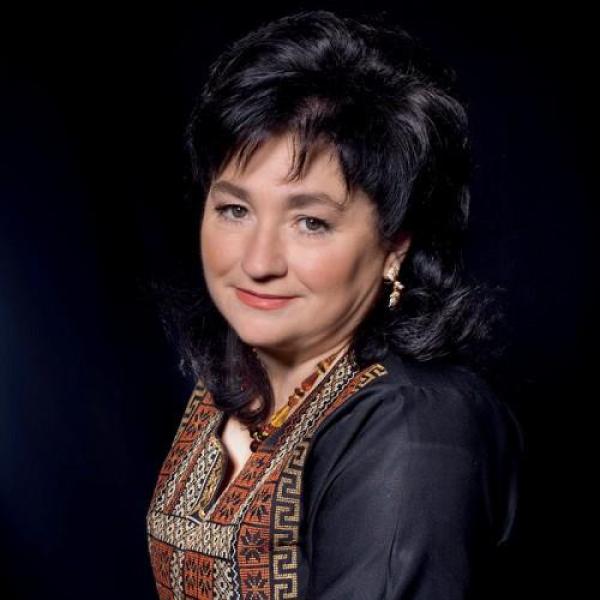
Maria Matios is a Ukrainian writer whose work seamlessly weaves together prose, poetry, and journalism.
Maria Vasylivna Matios was born on December 19, 1959, in the village of Roztoky, Bukovina. Her writing blends the personal, the historical, and the mystical, drawing deeply on the folklore of Bukovina, the region’s history, and the memory of her own family.
At the heart of Matios’s prose is the human experience under extreme circumstances: the traumas inflicted by totalitarianism, the weight of moral choices, the complexities of love, and the burdens of responsibility. Her works are marked by profound psychological insight, intense emotional resonance, and a distinctive style that fuses literary Ukrainian with regional dialects.
Selected translations of Maria Matios’s works into English:
- Sweet Darusya: A Tale of Two Villages – Spuyten Duyvil Publishing (2019)
- Hardly Ever Otherwise – Glagoslav Publications (2012)
In French:
- Daroussia la Douce
- Presque jamais autrement
Her novel Sweet Darusya, first published in Ukraine in 2003 and later translated into English, is widely regarded as a cornerstone of her literary career. In this work, the themes Matios develops throughout her prose—personal and collective trauma, memory, and the interplay of individual and community life—are most vividly realized. The novel explores how the events of the past shape inner lives and communal relationships, blending psychological depth with a rich portrayal of Bukovina’s regional environment.
Among her most celebrated works are: Nation, Hardly Ever Otherwise, Moskalytsia, Beech Land, Armageddon Has Already Happened, The Woman’s Noose in the Garden of Impatience, Diary of the Executed, The Virgin Mary’s Shoes, and Mothers. Across these works, she delves into family histories, the fates of women, the life of communities, and the dramatic upheavals of the 20th century. Her books have been widely republished, translated into multiple languages, and adapted for the stage.
Maria Matios has received numerous literary honors, including the prestigious Taras Shevchenko National Prize of Ukraine.
Extrait: Sweet Darusya: A Tale of Two Villages
... Once in the spring Ivan Tsvychok was chopping wood at Maria's, Darusya's nearest neighbor. How Maria convinced Tsvychok to go to work on her farmstead–God only knows. But facts are facts. Nearly the entire village looked and wondered how Ivan, taking off his checkered shirt, was able to wield his ax for nearly half a day–like a house on fire, and Maria was inexpressibly pleased.
You already know: no one can say that Ivan was such a good worker, because in the middle of working he could sit down on a stump or on a bench near the wall and either play the drymba, or gather up his clothes and start off toward the bus station.
He did almost the same at Maria's. He all of a sudden threw bis ax into the middle of the yard, and so–since he was bare to his waist–leaned up against the wooden fence, pulled out his drymba from his pants–and played in the direction of Darusya's yard some very sorrowful melody, so sorrowful that the chickens stopped rummaging in the dust, and the dog began to wag his tail and et off for the doghouse.
In the meantime, Darusya, tied in wedding ribbons, bareheaded, with a wreath on her head, in a long white embroidered shirt, all the way to her heels, slit halfway, sat in the dried out pear tree tying up the branches, taking off the ribbons from her hair one by one. One moment she lifted her gaze to the sky, the next moment–she stared into her hands–and a solitary tear rolled along her cheek as though along a dried out ditch.
And Tsvychok played his drymba and looked across the wooden fence, as though not at Darusya, but just at her yard, then suddenly stuffed the drymba into his pants, put on his shirt, took his ax, silently opened up the gate to Darusya's farmstead, and started to chop her wood that had been carelessly tossed near the wall of her shed perforated with holes on every side.
Darusya kept looking at Ivan from the pear tree. She wiped her tears and slowly crawled off the tree, leaving the wreath from her head on a branch.
While she carried the wood into the shed and tidily stacked it by the wall, then gathered the chips and stacked them separately, then swept the yard, in the meantime Ivan again began playing the drymba, repeating to himself under his breath:
"Damn those dumb people, who from a smart person make a dumb one," and spat from time to time at his feet.
After all this Darusya opened the door for Ivan to her entryway.
Tsvychok entered her house in the same way in silence.
Maria just shrugged her shoulders in her yard: sweet Darusya doesn't open the door of her house by herself for anyone.
... From that day Ivan Tsvychok moved into Darusya's house.
Most often the days in their yard passed approximately this way: Ivan fashions a drymba-and Darusya, with a braid arranged nicely around her head, looks out from the shed, crossing her arms over her chest. And so in a somewhat domestic way, warmly, with a barely smiling face, she stands stationary and devours his work with her eyes.
Tsvychok silently keeps making the drymbas–and takes a bag filled with them somewhere out into the world for a week. And then from Storonets to Vyzhnytsia, from Vyzhnytsia to Kuty and Verkhovyna, in the passenger compartments of buses, the drymba quivers in his lips like a virgin just before sinning, and he extracts from it first humorous, then compassionate melodies–so that one day a certain young woman from Roztoky with packs and buckets of cherries rode all the way to Yablunytsia, missing her stop at Roztoky because she had become enamored of Tsvychok's playing.
The days of selling passed–and as strange as it was, from spring to fall Ivan returned to Darusya's yard and took to working first with his ax: to fix the wooden fence, to put the gate in order, to chop wood–and there again made his drymbas.
And it happened, in the middle of making drymbas, he simply sits down in the middle of the yard and takes a drymba to his lips. And after that there's no work going on either in this or in the neighbor Maria's livestock pen, because the two women are sitting on two opposite sides of the fence–each thinking her own thoughts, if she is still able to think, and Tsvychok extracts such sorrow from the body of the drymba that your heart would break even if it were made of stone.
... A heart is a heart, but when Darusya heard the voice of Ivan's drymba, her head never ached.
Then she would walk around the edge of the garden, or listen to the simple emotive melody, bowing her head to her knees, or would sit with Maria by the wall on a bench-and the iron rings pressing on her head fell from her like leaves from a tree, and it somehow became so easy–she didn't even feel like opening her eyes in the morning, and just wanted to lie that way-on the bed or in a sunny spot-and be happy that the pain had disappeared, as if she had never had it.
And maybe only Maria knew that Darusya's head doesn't ache, and that she's not running to the water, and not digging holes for herself in the earth, and not climbing up the pear tree when Ivan takes to playing his drymba. So Maria was willing to carry crocks of borsht or mashed beans, a little thick gruel, or a piece of pig lard to her neighbors every day so that Ivan would just not be hungry, so that he had the strength to play the drymba. Because Tsvychok's ribs shone through his shirt-no one knows if his family was that gaunt, or whether a restless life had so dried out the man.
And Ivan oftentimes returns Maria's meals, painting to a pot of cooked potatoes or a cast iron pot of thick gruel, and adds calling after her:
"You think you're a gazda, and I don't disagree, but my arms don't grow out of my ass, Maria."
So when Ivan was in the village, nearly every day he sat clown with his drymba on the threshold with Darusya near him. And just like that the day passed for them.
And then a few days passed–Ivan again made his drymbas or set off into the wide world with them, and Darusya fell in the house on her bed–and for entire days at a time looked at the ceiling, not raising herself up either to her food or to the stove, not even to a lonesome chicken that was pecking right at the windows .... "
"Birds of a feather flock together," the young women in the village, lovers of lies and scandais, shrugged their shoulders. On the other hand no scandals ever left Darusya's yard, unless Ivan got out of hand on buses as never before. lt was frightening to offend him, because he might utter something from which you'd need to flee the village.