
Deborah Levy
Deborah Levy is a British playwright, poet, and novelist, born on 6 August 1959 in Johannesburg. She grew up in a European settler family in South Africa, in a society fractured by apartheid, an experience that would later inform the political and emotional depth of her writing. Her early studies and creative beginnings led her first to the theatre, but it was in the novel that her voice found its fullest expression, bringing her both critical acclaim and public recognition.
Her most notable novels are:
- Swimming Home (2011)
- Hot Milk (2016)
- The Man who Saw Everything (2019)
In French:
- Ce que je ne veux pas savoir
- Le coût de la vie
- Etat des lieux
- Position de la cuillere
- Sous l’eau
- Hot Milk
- Bleu d’août
- Une année à Paris avec Gertude Stein
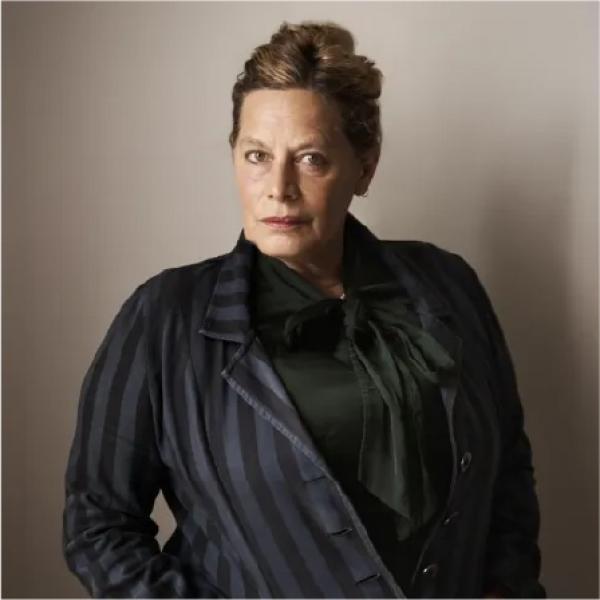
Today, Levy is celebrated as one of the most compelling feminist writers of her generation. Her work offers a bold and intimate exploration of a woman’s life lived within the urgency of the present tense, posing searching questions about womanhood, modernity, creative identity, and personal freedom. Nowhere is this vision more powerfully articulated than in her innovative “Living Autobiography” trilogy—Things I Don’t Want to Know (2014), The Cost of Living (2018), and Real Estate (2021)—in which she reimagines memoir as a space of reflection, resistance, and self-invention, speaking in a voice that is at once precise, restless, and unmistakably her own.
Extrait: Real Estate
… Celia was one of the few women I knew who was very like herself. She was more like herself than I was like myself. She did not try to please anyone and certainly did not fit patriarchy's idea of what an old woman should be like: patient, self-sacrificing, servicing everyone's needs, pretending to be cheerful when she felt suicidal. If old women are supposed to not want to cause any trouble, Celia had decided to cause as much trouble as possible. The trouble was how to live a creative life in old age. The son of a friend of Celia's was living in the attic of her big house. In return for free accommodation, he was doing some of the caring along with the official carer. Sometimes it became too much for him, so with Celia's permission he invited his best pal from Manchester to help out. These two young men, both of them students in their mid-twenties, kept the house cheerful, put up with Celia's volatile moods, cooked imaginative meals, played music that everyone enjoyed, and as anyone who has been in this caring situation will know, they had tremendous responsibilities to handle while they studied for their academic degrees.
Sometimes when I arrived to listen to Celia read from The Hearing Trumpet, one of the boys would be marinating a leg of lamp in something weird, like sultanas and balsamic vinegar, to which Celia, quoting from The Hearing Trumpet, remarked: 'I never eat meat as I think it is wrong to deprive animals of their life when they are so difficult to chew anyway.' It seemed to me all over again that in every phase of living we do not have to conform to the way our life has been written for us, especially by those who are less imaginative than ourselves …